Introduction
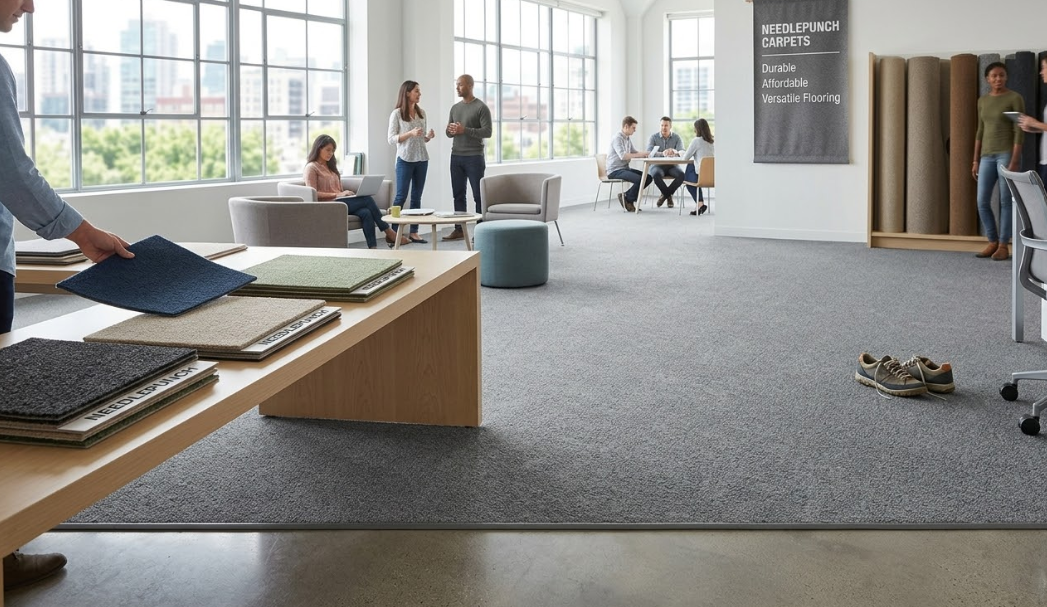
When it comes to choosing flooring that balances affordability, durability, and practical performance, needlepunch carpets consistently rise to the top of the conversation. They’re the unsung heroes of the flooring world — quietly lining offices, exhibition halls, hotel corridors, mosques, and residential spaces across Dubai without demanding attention or breaking budgets.
But here’s the honest truth. Most people have walked on needlepunch carpets hundreds of times without ever knowing what they’re called. That flat, dense, felt-like carpet under your feet at the last trade show? Needlepunch. The hard-wearing carpet running through your office building’s corridors? Almost certainly needlepunch. The affordable yet surprisingly comfortable carpet in your apartment’s bedrooms? Quite possibly needlepunch too.
Despite being everywhere, this carpet type rarely gets the detailed attention it deserves. Most online resources offer surface-level overviews that leave buyers with more questions than answers. What exactly makes needlepunch different from tufted or woven carpet? Which type works best in Dubai’s demanding climate? How long does it actually last? Is it suitable for your specific project?
This guide changes that. We’ve put together everything you need to know about needlepunch carpets — from how they’re manufactured and why they perform so well, to practical buying advice, installation methods, maintenance routines, and real-world applications across Dubai and the UAE.
Whether you’re fitting out a commercial space, renovating a residential property, or planning a large-scale event, this guide will help you make a confident, well-informed decision.
What Are Needlepunch Carpets? Understanding the Basics
Needlepunch carpets — also called needle-felt carpets or non-woven carpets — are manufactured using a mechanical process that’s fundamentally different from traditional tufted or woven carpets. Understanding this process helps explain why needlepunch carpets behave the way they do.
How They’re Made
The manufacturing process involves several key stages:
- Fibre Selection: Synthetic fibres — most commonly polypropylene (PP) or polyester (PET) — are selected and prepared. Some manufacturers also use recycled fibres, making certain needlepunch products more environmentally sustainable.
- Web Formation: The fibres are carded (combed and aligned) and layered into a thick, fluffy web. Multiple layers are stacked to achieve the desired weight and density.
- Needling: This is the defining step. The fibre web passes through a needling machine equipped with thousands of barbed needles. These needles repeatedly punch down through the fibre layers at high speed — typically 800 to 2,500 punches per minute. Each needle stroke tangles and interlocks the fibres mechanically, binding them together without thread, adhesive, or heat.
- Finishing: The needled fabric may undergo additional treatments:
- Calendering (heat and pressure) for a smoother surface
- Printing for patterns and colours
- Latex backing for dimensional stability and added durability
- Anti-static treatment for office and data centre environments
- Flame-retardant coating for commercial compliance
The result is a dense, flat, felt-like carpet that’s remarkably tough and dimensionally stable.
Key Characteristics at a Glance
| Characteristic | Description |
|---|---|
| Construction | Mechanically interlocked fibres (no weaving or tufting) |
| Primary Fibres | Polypropylene, polyester, or recycled blends |
| Pile Height | Very low or flat (no defined pile loops or cuts) |
| Texture | Dense, firm, felt-like surface |
| Weight Range | 200 to 800 g/sqm (varies by application) |
| Backing | Usually latex, PVC, or action-back |
| Primary Use | Commercial, event, automotive, residential |
| Lifespan | 3–15+ years depending on quality and traffic |
Types of Needlepunch Carpets Available in Dubai
Not all needlepunch carpets are created equal. The market offers several distinct types, each designed for specific applications and performance requirements.
1. Plain Needlepunch Carpet
The most basic and affordable option. Solid colours with a uniform, flat surface. Available in rolls — typically 2m or 4m widths — and in a wide range of colours.
Best for: Budget-conscious projects, temporary installations, event flooring, underlay
Typical weight: 200–400 g/sqm
2. Velour Needlepunch Carpet
A step up in quality and aesthetics. The surface is lightly brushed or finished to create a softer, slightly velvety texture. Still flat, but more pleasant underfoot and visually refined.
Best for: Office spaces, retail environments, residential bedrooms, hotel corridors
Typical weight: 350–550 g/sqm
3. Rib Needlepunch Carpet
Features distinctive parallel lines or grooves running across the surface. This ribbed texture adds visual interest, improves dirt-hiding capability, and enhances slip resistance.
Best for: Entrances, corridors, high-traffic commercial areas, schools
Typical weight: 400–600 g/sqm
4. Printed Needlepunch Carpet
Patterns, designs, logos, or images are digitally or screen-printed onto the carpet surface. Modern printing technology allows for remarkably detailed and vibrant designs.
Best for: Exhibitions, trade shows, branded environments, themed commercial spaces, event venues
Typical weight: 300–500 g/sqm
5. Automotive Needlepunch Carpet
Specially engineered for vehicle interiors — car boots, floor linings, and trunk compartments. These products meet specific automotive industry standards for weight, flammability, and abrasion resistance.
Best for: Vehicle manufacturing, automotive upholstery, marine applications
6. Heavy-Duty Commercial Needlepunch
Premium-grade products with higher fibre density, reinforced backing, and enhanced wear resistance. Often tested and certified to international commercial flooring standards.
Best for: Airports, shopping malls, hospitals, government buildings, large corporate offices
Typical weight: 500–800+ g/sqm
Why Choose Needlepunch Carpets? Key Benefits Explained
Let’s explore why this carpet type has earned such widespread adoption across residential and commercial sectors in Dubai.
Exceptional Durability
The mechanical interlocking of fibres creates a structure that resists fraying, unravelling, and edge deterioration. Unlike tufted carpets where individual yarn loops can pull out, needlepunch fibres are entangled throughout the entire thickness of the carpet. There’s no pile to flatten, no loops to snag, and no seams to separate.
According to the Carpet and Rug Institute (CRI), needlepunch construction is particularly resistant to the types of wear common in high-traffic commercial environments, making it a standard specification for corridors, lobbies, and public areas.
Outstanding Value for Money
This is arguably the single biggest advantage. Needlepunch carpets cost significantly less than tufted, woven, or luxury carpet tile alternatives:
| Carpet Type | Typical Cost Range (AED/sqm) |
|---|---|
| Plain Needlepunch | AED 8 – 25 |
| Velour Needlepunch | AED 20 – 50 |
| Commercial Needlepunch | AED 35 – 80 |
| Tufted Broadloom | AED 60 – 200+ |
| Woven Carpet | AED 150 – 500+ |
| Carpet Tiles | AED 40 – 180 |
For large-scale projects — fitting out an entire office floor, covering event spaces, or carpeting multiple apartment units — this cost differential adds up to substantial savings.
Moisture and Stain Resistance
Polypropylene and polyester fibres are inherently hydrophobic — they don’t absorb water. This means needlepunch carpets:
- Resist liquid stains effectively
- Dry quickly if wet
- Don’t support mould or mildew growth
- Won’t develop odours from moisture absorption
In Dubai’s environment, where spilled beverages, cleaning routines, and occasional humidity are facts of life, this resistance is genuinely valuable.
Easy Installation
Needlepunch carpets are lightweight, flexible, and straightforward to install. They can be:
- Loose-laid with double-sided tape for temporary installations
- Fully adhered with spray or roll-on adhesive for permanent installations
- Cut to size with simple tools (utility knife and straight edge)
A professional installation team can cover large areas quickly, reducing labour costs and minimising disruption to occupied spaces.
Low Maintenance Requirements
The dense, flat surface doesn’t trap dirt the way deep pile carpets do. Regular vacuuming and occasional spot cleaning keep needlepunch carpets looking fresh. There’s no pile to groom, no crushing to worry about, and no complex cleaning protocols required.
Sound and Thermal Insulation
While not as plush as thick tufted carpets, needlepunch products do provide meaningful acoustic and thermal benefits. They absorb impact sound (footsteps, dropped objects) and add a layer of thermal insulation between the subfloor and the occupied space.
Research published by the European Carpet and Rug Association (ECRA) confirms that even low-pile textile floor coverings reduce impact noise by 20–30 dB compared to hard surfaces — a significant improvement in comfort, particularly in apartment buildings and multi-storey offices.
Fire Safety Compliance
Commercial-grade needlepunch carpets are manufactured with flame-retardant treatments that meet international safety standards, including:
- Cfl-s1 or Bfl-s1 classification under EN 13501-1 (European fire classification)
- ASTM E648 (Critical Radiant Flux test for commercial flooring)
- BS 4790 (British Standard hot metal nut test)
For commercial fit-outs in Dubai, fire safety compliance is mandatory. The Dubai Civil Defence requires all interior materials, including carpets, to meet approved fire rating standards. Quality needlepunch manufacturers provide the necessary test certificates to satisfy these requirements.
Needlepunch Carpets vs. Other Carpet Types: A Detailed Comparison
Understanding how needlepunch stacks up against alternatives helps you make the right choice for your specific situation.
| Feature | Needlepunch | Tufted Broadloom | Woven | Carpet Tiles |
|---|---|---|---|---|
| Cost | ✅ Very affordable | ⚠️ Moderate to high | ❌ Expensive | ⚠️ Moderate |
| Durability | ✅ Excellent | ✅ Good to excellent | ✅ Excellent | ✅ Good to excellent |
| Comfort Underfoot | ⚠️ Firm, not plush | ✅ Soft and cushioned | ✅ Luxurious | ⚠️ Varies |
| Installation Speed | ✅ Very fast | ⚠️ Moderate | ❌ Slow | ✅ Fast |
| Maintenance | ✅ Very easy | ⚠️ Moderate | ⚠️ Moderate | ✅ Easy (replaceable) |
| Moisture Resistance | ✅ High | ❌ Low (most types) | ❌ Low | ⚠️ Moderate |
| Design Options | ⚠️ Limited (improving) | ✅ Extensive | ✅ Extensive | ✅ Extensive |
| Acoustic Performance | ⚠️ Moderate | ✅ Good | ✅ Good | ⚠️ Moderate |
| Eco-Friendliness | ✅ Often recyclable | ⚠️ Varies | ⚠️ Varies | ⚠️ Varies |
| Best Application | Commercial, events, budget residential | Luxury residential, hotels | Premium hospitality, heritage | Modern offices, retail |
The takeaway is clear: needlepunch carpets win on cost, durability, moisture resistance, and ease of maintenance. They concede ground on luxury feel and design variety — but for many applications, those trade-offs are perfectly acceptable.
Where Are Needlepunch Carpets Used? Real-World Applications in Dubai
The versatility of needlepunch carpets means they appear across a remarkable range of settings. Here are the most common applications we see in Dubai:
Commercial Offices
Open-plan offices, server rooms, meeting rooms, and corridors frequently specify needlepunch carpets for their cost-effectiveness and durability. In large corporate fit-outs covering thousands of square metres, the material cost savings alone can be substantial.
Exhibition and Event Venues
Dubai hosts world-class events year-round — from GITEX and Arab Health to the Dubai International Boat Show and Art Dubai. Needlepunch carpet is the standard choice for exhibition booths, temporary walkways, and event staging because:
- It’s inexpensive enough to be used once and replaced
- Available in branded colours for corporate identity
- Quick to install and remove
- Recyclable after use
Dubai World Trade Centre, the Dubai Exhibition Centre at Expo City, and most major event venues regularly use needlepunch carpet for these purposes.
Mosques and Prayer Halls
Needlepunch carpets are widely used in mosques and prayer spaces across the UAE. Their flat, firm surface provides a stable base for prayer, while the dense construction resists wear from constant foot traffic. Anti-bacterial and fire-retardant treatments add additional suitability.
Residential Applications
In apartment buildings and villa communities, needlepunch carpets are commonly used for:
- Bedroom flooring (especially in rental properties)
- Children’s playrooms
- Home offices
- Staircase runners
- Storage and utility rooms
For landlords managing multiple rental units, needlepunch offers a practical balance of comfort, appearance, and replacement cost.
Hospitality and Retail
Hotel back-of-house areas, retail stockrooms, gym floors, and restaurant service corridors benefit from needlepunch’s combination of durability and easy cleaning. Some boutique hotels and retail concepts also use printed needlepunch as a design feature in their front-of-house areas.
Automotive and Marine
Vehicle interiors — from car trunk linings to bus and marine vessel flooring — rely on specialised needlepunch products that meet automotive-grade performance standards.
Outdoor and Semi-Outdoor Spaces
UV-stabilised needlepunch carpets are used in covered outdoor areas, temporary tents, balconies, and terraces where weather resistance and drainage capability are important.
How to Choose the Right Needlepunch Carpet: Expert Buying Guide
With so many options available, making the right selection requires considering several factors. Here’s our professional framework:
1. Define Your Application
Start with the end use. A mosque prayer carpet has different requirements than an exhibition floor or a bedroom carpet. Be specific about:
- Expected foot traffic volume (light, moderate, heavy, extreme)
- Duration of use (temporary or permanent)
- Aesthetic expectations (basic or refined)
- Special requirements (fire rating, anti-static, anti-bacterial)
2. Choose the Right Weight
Carpet weight (measured in grams per square metre) directly correlates with density, durability, and feel:
- 200–300 g/sqm: Lightweight. Suitable for temporary events, single-use exhibitions, and protective covering during construction.
- 300–450 g/sqm: Mid-weight. Good for general commercial use, residential bedrooms, and moderate-traffic corridors.
- 450–600 g/sqm: Heavy-weight. Ideal for high-traffic commercial environments, prayer halls, and long-term installations.
- 600–800+ g/sqm: Premium grade. Specified for airports, malls, hospitals, and demanding public spaces.
3. Select the Appropriate Fibre
Polypropylene (PP):
- Most affordable option
- Good moisture and stain resistance
- UV-resistant grades available
- Lower melting point (avoid near heat sources)
- Most common choice for commercial needlepunch
Polyester (PET):
- Slightly softer hand feel
- Excellent colour retention
- Available in recycled variants (rPET) for sustainability
- Good choice for residential and hospitality applications
Blended Fibres:
- Combine properties of multiple fibre types
- Can optimise cost, durability, and feel simultaneously
4. Evaluate the Backing
The backing material affects dimensional stability, installation method, and long-term performance:
- Latex backing: Flexible, stable, good for adhesive installation. Most common option.
- PVC backing: More rigid, very durable, excellent moisture barrier. Heavier.
- Action-back (woven polypropylene): Lightweight, cost-effective, good for loose-laid installations.
- Self-adhesive backing: Peel-and-stick convenience for small areas and temporary use.
- Gel-foam backing: Added cushioning and sound absorption. Premium option.
5. Check Certifications
For commercial projects in Dubai, ensure your chosen product meets:
- Dubai Civil Defence fire rating requirements
- EN 1307 (European textile floor covering classification)
- EN 13501-1 (fire classification for construction products)
- ISO 9001 (quality management certification for the manufacturer)
- OEKO-TEX Standard 100 (tested for harmful substances — important for indoor air quality)
6. Request Samples
Never commit to a large order based on catalogue images alone. Order physical samples and evaluate them in your actual space. Check:
- Colour accuracy under your lighting conditions
- Surface texture and hand feel
- Thickness and density
- Edge quality and flexibility
- Odour (some low-quality products off-gas initially)
Installation Guide for Needlepunch Carpets
Proper installation ensures maximum performance and lifespan. Here’s the professional process:
Subfloor Requirements
The subfloor must be:
- Clean: Free of dust, debris, oil, and loose material
- Dry: Moisture content below 3% for concrete subfloors
- Smooth: Minor imperfections can telegraph through thin carpet
- Level: Variations of no more than 3mm over 2 metres
In Dubai, most commercial and residential subfloors are concrete screed, which provides an excellent base for needlepunch carpet installation.
Installation Methods
Method 1: Full Adhesive (Recommended for Permanent Installations)
- Apply a thin, even coat of appropriate carpet adhesive to the subfloor
- Allow the adhesive to become tacky (follow manufacturer’s specifications)
- Roll out the carpet and press firmly into the adhesive
- Use a carpet roller (minimum 30kg) to ensure full contact and eliminate air pockets
- Trim edges with a sharp utility knife
- Seal seams with seam tape or welding for heavy commercial use
Method 2: Double-Sided Tape (Semi-Permanent Installations)
- Apply double-sided carpet tape along all edges and at regular intervals
- Roll out the carpet over the tape
- Press firmly along all taped areas
- Trim edges cleanly
Method 3: Loose-Lay (Temporary Installations)
- Roll out the carpet across the floor area
- Allow it to relax and flatten naturally
- Trim edges to fit
- Secure edges with tape or gripper bars if needed
- Use carpet weights or furniture to prevent shifting
Seaming
For large areas requiring multiple carpet widths:
- Overlap edges by approximately 20mm
- Double-cut through both layers simultaneously for a perfect seam match
- Apply seam adhesive or hot-melt seam tape
- Press seam edges firmly together
- Roll with a seam roller to ensure a flush, invisible joint
Cutting Around Obstacles
- Create relief cuts for pillars, door frames, and irregular shapes
- Use a template for complex curves
- Leave a slight gap (2–3mm) around fixed objects for expansion
Maintenance and Care for Needlepunch Carpets
One of needlepunch carpet’s greatest advantages is its straightforward maintenance routine.
Daily Maintenance
- Vacuum with a standard upright or cylinder vacuum cleaner
- Use a hard-floor or low-pile setting — no beater bars needed
- Focus on high-traffic paths and entrance areas
- Remove loose debris and sand promptly (especially important in Dubai)
Weekly Maintenance
- Spot clean any stains using a mild detergent solution and clean cloth
- Blot — never rub — to prevent spreading
- For stubborn stains, use a carpet-specific stain remover approved for synthetic fibres
- Allow cleaned areas to dry completely
Monthly Maintenance
- Deep vacuum the entire carpeted area, including edges, corners, and under furniture
- Inspect for any signs of wear, lifting, or seam separation
- Address any issues promptly before they worsen
Annual Maintenance
- Professional hot water extraction cleaning (commonly called steam cleaning) revitalises the carpet’s appearance and removes deep-seated dirt
- For large commercial spaces, consider a professional scrubbing and extraction service
- Apply anti-static treatment if required
Stain Removal Guide
| Stain Type | Removal Method |
|---|---|
| Coffee / Tea | Blot immediately, apply mild detergent solution, rinse with damp cloth |
| Ink | Apply isopropyl alcohol on a cloth, blot gently, rinse |
| Oil / Grease | Apply dry-cleaning solvent, blot, follow with detergent solution |
| Chewing Gum | Freeze with ice cubes, scrape off carefully, clean residue with solvent |
| Red Wine | Blot immediately, apply salt to absorb, clean with vinegar-water solution |
| Blood | Cold water only (never hot), apply hydrogen peroxide for stubborn stains |
Sustainability and Environmental Considerations
Environmental responsibility matters increasingly to Dubai’s developers, building owners, and consumers. Here’s where needlepunch carpets stand:
Positive Environmental Aspects
- Recyclable: Many needlepunch carpets are mono-material (100% polypropylene), making them fully recyclable at end of life
- Recycled content: Products made from recycled PET bottles are increasingly available, diverting plastic waste from landfills
- Low waste manufacturing: The needlepunch process generates minimal waste compared to tufted or woven carpet production
- No water-intensive dyeing: Solution-dyed fibres (where colour is added during fibre production) eliminate water-intensive dyeing processes
- Energy-efficient production: The mechanical needling process requires less energy than thermal bonding or weaving
Areas for Improvement
- Synthetic fibres are petroleum-derived (though recycled options mitigate this)
- Some backing materials (PVC) have environmental concerns
- End-of-life carpet recycling infrastructure is still developing in the UAE
The Dubai government’s sustainability initiatives, including the Dubai Clean Energy Strategy 2050 and the UAE’s Net Zero 2050 target, are driving demand for more sustainable building materials. Choosing needlepunch carpets with recycled content and recyclable construction aligns with these goals.
Cost Analysis: Needlepunch Carpets for Dubai Projects
Let’s break down realistic costs for typical Dubai projects:
Small Residential Project (50 sqm — Apartment Bedrooms)
| Item | Cost (AED) |
|---|---|
| Velour needlepunch carpet (400 g/sqm) | AED 1,250 – 2,000 |
| Adhesive and accessories | AED 200 – 400 |
| Professional installation | AED 500 – 1,000 |
| Total | AED 1,950 – 3,400 |
Medium Commercial Project (300 sqm — Office Floor)
| Item | Cost (AED) |
|---|---|
| Commercial needlepunch (500 g/sqm) | AED 12,000 – 18,000 |
| Adhesive and accessories | AED 1,200 – 2,000 |
| Professional installation | AED 3,000 – 6,000 |
| Total | AED 16,200 – 26,000 |
Large Event Installation (1,000 sqm — Exhibition)
| Item | Cost (AED) |
|---|---|
| Plain needlepunch (250 g/sqm) | AED 8,000 – 15,000 |
| Tape and accessories | AED 1,000 – 2,000 |
| Installation and removal | AED 5,000 – 10,000 |
| Total | AED 14,000 – 27,000 |
These figures demonstrate why needlepunch carpets dominate budget-conscious and large-scale projects. The cost per square metre is simply unmatched by other carpet types.
Pros and Cons Summary
✅ Pros
- Extremely cost-effective across all project sizes
- Outstanding durability in high-traffic environments
- Moisture, stain, and mould resistant
- Quick and simple installation
- Low maintenance requirements
- Wide range of colours and increasing design options
- Fire-retardant options available for commercial compliance
- Recyclable and available with recycled content
- Dimensionally stable — won’t stretch, shrink, or wrinkle
- Resistant to insects, rot, and biological degradation
❌ Cons
- Less luxurious underfoot than tufted or woven carpets
- Limited design complexity compared to printed carpet tiles
- Flat appearance may look basic in upscale residential settings
- Can feel firm compared to cushioned broadloom carpets
- Quality varies significantly between manufacturers
- Lower-grade products may show wear in heavily used paths
- Not suitable where deep cushioning or sound absorption is the primary requirement
Frequently Asked Questions About Needlepunch Carpets
How long do needlepunch carpets typically last?
Lifespan depends heavily on quality and traffic levels. Lightweight event carpets may last just one use. Mid-weight commercial products typically last 5 to 10 years in moderate traffic areas. Heavy-duty premium products can exceed 15 years with proper maintenance. For most Dubai office and residential applications, expect 7 to 12 years from a quality product.
Are needlepunch carpets suitable for Dubai’s climate?
Yes, they’re actually well-suited. The synthetic fibres (polypropylene and polyester) don’t absorb moisture, resist mould growth, and maintain their properties across temperature variations. UV-stabilised versions are available for covered outdoor areas. The key consideration is ensuring adequate air conditioning in indoor spaces to prevent heat-related adhesive softening.
Can needlepunch carpets be used in bathrooms or wet areas?
While the carpet itself resists moisture effectively, permanent installation in consistently wet areas isn’t recommended. Water can penetrate seams and edges, potentially causing subfloor issues. For occasionally damp areas like covered balconies or utility rooms, needlepunch with appropriate backing performs well.
Are needlepunch carpets safe for children?
Yes. Quality products that carry OEKO-TEX Standard 100 certification have been tested for harmful substances and are safe for direct skin contact, including for children. The flat surface also reduces tripping hazards compared to deep pile carpets, and the cushioning effect provides some protection from falls on hard subfloors.
Can needlepunch carpet be installed over existing flooring?
In most cases, yes. Needlepunch can be laid over existing vinyl, tile, or concrete surfaces as long as the subfloor is clean, dry, level, and structurally sound. Installing over existing carpet is not recommended, as the soft underlayer creates instability and accelerates wear.
How do I dispose of old needlepunch carpet responsibly?
Contact local waste management services for guidance on carpet recycling options in Dubai. Mono-material polypropylene carpets are recyclable where appropriate facilities exist. Some manufacturers and distributors offer take-back programmes. For large commercial quantities, specialised recycling companies in the UAE can process carpet waste.
What’s the difference between needlepunch and felt carpet?
They’re closely related. Needlepunch is technically a type of needle-felt — the terms are often used interchangeably. However, “felt” can also refer to wool-based products made through traditional felting processes (heat, moisture, and pressure). Most modern needlepunch carpets use synthetic fibres and mechanical needling rather than traditional felting.
Can I install needlepunch carpet myself?
For small, simple areas — yes. The material is forgiving to work with and requires only basic tools (utility knife, straight edge, measuring tape, adhesive or tape). However, for large areas, complex room shapes, or commercial projects where appearance and longevity matter, professional installation is strongly recommended. The cost of professional installation is modest relative to the value it adds.
Conclusion
Needlepunch carpets represent one of the most practical, versatile, and cost-effective flooring solutions available in Dubai today. From bustling office corridors and world-class exhibition halls to quiet residential bedrooms and sacred prayer spaces, this humble carpet type delivers reliable performance without demanding excessive investment or attention.
Its core strengths — durability, moisture resistance, easy maintenance, and exceptional value — make it the natural choice for projects where budgets matter but quality can’t be compromised. And with ongoing improvements in printing technology, fibre quality, and sustainable manufacturing, needlepunch carpets are steadily closing the gap with more expensive alternatives in terms of aesthetics and environmental responsibility.
The keys to a successful needlepunch carpet project are straightforward: select the appropriate weight and fibre type for your specific application, ensure proper subfloor preparation, invest in professional installation for permanent projects, and follow a simple regular maintenance routine.
If you’re planning a flooring project in Dubai and want expert guidance on choosing and installing needlepunch carpets, the experienced team at Interior Design Dubai is ready to help. We work with trusted manufacturers, offer competitive pricing, and bring hands-on expertise to every project — from small residential installations to large-scale commercial fit-outs.
Reach out today for a free consultation, product samples, and a customized quote for your project.