Introduction
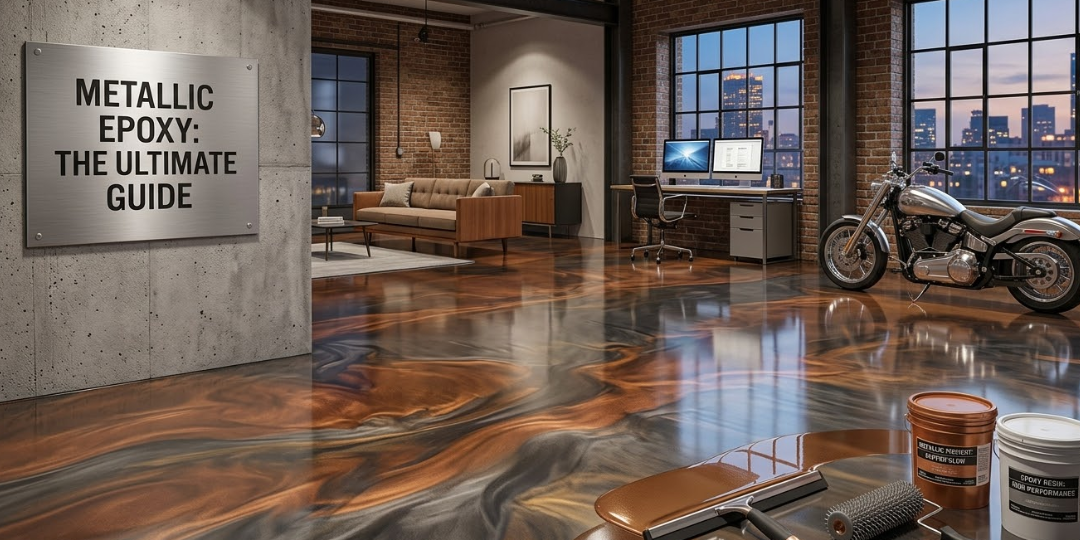
Some flooring options blend quietly into the background. Metallic epoxy flooring is not one of them. It demands attention. It catches light in unexpected ways. It creates depth, movement, and visual drama that no other flooring material can replicate — turning ordinary concrete into what looks like liquid metal, molten lava, ocean currents, or swirling galaxies frozen beneath a glass-smooth surface.
Walk into a luxury car showroom in Dubai, a high-end retail boutique, a contemporary penthouse lobby, or a cutting-edge restaurant, and there’s a growing chance the floor beneath your feet is metallic epoxy. This flooring system has exploded in popularity across the UAE over the past decade, and for good reason. It delivers a combination of jaw-dropping aesthetics and industrial-grade durability that almost no other flooring solution can match.
But metallic epoxy is also one of the most misunderstood flooring options on the market. The stunning Instagram photos make it look effortless. The reality is that achieving those results requires deep technical knowledge, premium materials, skilled application, and an understanding of how environmental conditions — particularly Dubai’s extreme heat and humidity variations — affect every stage of the process.
This guide pulls back the curtain on everything you need to know about metallic epoxy flooring. We’ll cover what it actually is, how it works, why it performs so well, where it’s best used, how much it costs in Dubai, and — critically — how to avoid the common mistakes that turn a dream floor into a costly disappointment.
Whether you’re a homeowner exploring options for a villa renovation, a business owner planning a commercial fit-out, or a designer specifying materials for a client project, this comprehensive resource will give you the knowledge to make confident, informed decisions.
Let’s dive deep.
What Is Metallic Epoxy Flooring? The Science Behind the Shimmer
At its core, metallic epoxy flooring is a multi-layer resinous flooring system that combines high-performance epoxy or polyaspartic resins with metallic pigment additives to create a three-dimensional, luminous floor surface.
But that technical description barely scratches the surface of what makes this system special. Let’s break it down layer by layer.
The Layer Structure
Every metallic epoxy floor consists of several carefully applied layers:
| Layer | Material | Purpose |
|---|---|---|
| Substrate | Concrete slab | Structural base |
| Surface preparation | Mechanical grinding/shot blasting | Creates profile for adhesion |
| Primer coat | Epoxy primer | Seals concrete and ensures bond |
| Base coat | Pigmented epoxy (optional) | Establishes background colour |
| Metallic coat | Epoxy resin + metallic pigments | Creates the visual effect |
| Top coat | Clear epoxy or polyaspartic | Protects, adds depth and gloss |
| Optional sealer | Polyurethane or polyaspartic | UV protection and chemical resistance |
How the Metallic Effect Works
The magic of metallic epoxy lies in the interaction between the resin and the metallic pigment particles. Here’s what happens:
- Metallic pigments — ultra-fine particles of mica, aluminium, or synthetic pearlescent materials — are mixed into clear or tinted epoxy resin.
- When the mixture is applied to the floor, the installer uses various techniques — rollers, squeegees, brushes, blowers, or even spiked shoes — to manipulate the wet epoxy and move the metallic particles within it.
- As the pigments shift, they orient at different angles relative to the surface. Some face upward, catching direct light. Others tilt sideways, reflecting light differently. Still others settle at deeper levels within the resin thickness.
- This multi-directional pigment orientation creates depth, movement, and three-dimensional visual effects — the signature look of metallic epoxy. Light reflecting off particles at different depths and angles produces the appearance of flowing liquid, marbled stone, or celestial patterns.
- When the clear top coat is applied over the cured metallic layer, it adds even more depth — like looking through clear water to the patterns below.
Why No Two Metallic Epoxy Floors Are Identical
This is both the beauty and the challenge of metallic epoxy. Because the final pattern depends on:
- How the installer manipulates the wet resin
- The ambient temperature and humidity during application
- The specific metallic pigments used
- The thickness of application
- The timing of manipulation techniques
…every single metallic epoxy floor is genuinely one-of-a-kind. You can guide the general colour scheme and style, but the exact pattern that emerges is unique to that specific installation. It’s part art, part science — and that’s precisely what makes it special.
Types of Metallic Epoxy Flooring Systems
Not all metallic epoxy systems are the same. Understanding the differences helps you choose the right product for your specific application.
1. Standard Metallic Epoxy
The most common system. Two-component epoxy resin mixed with metallic pigment powders. Applied by roller or squeegee, then manipulated while wet to create patterns.
Characteristics:
- Moderate working time (30–45 minutes before hardening begins)
- Rich depth and colour saturation
- Requires controlled environment during application
- Typically needs 24–72 hours before foot traffic
- Full cure in 5–7 days
Best for: Residential spaces, retail environments, showrooms, restaurants
2. Polyaspartic Metallic System
Uses polyaspartic resin instead of traditional epoxy. Polyaspartic is a type of polyurea coating that cures much faster and offers superior UV resistance.
Characteristics:
- Very fast cure time (walk-on in 4–6 hours)
- Excellent UV stability — won’t yellow over time
- Shorter working window (requires experienced installers)
- Better chemical resistance than standard epoxy
- Can be applied at wider temperature ranges
Best for: Commercial spaces needing fast turnaround, outdoor covered areas, UV-exposed locations, garage floors
3. Hybrid Metallic System (Epoxy + Polyaspartic)
Combines the depth and working time of epoxy for the metallic coat with a polyaspartic top coat for UV protection and rapid return to service.
Characteristics:
- Best of both worlds — artistic control plus durability
- Metallic layer in epoxy (longer manipulation time)
- Clear top coat in polyaspartic (UV stable, fast cure)
- Premium system used by top-tier installers
Best for: High-end residential, luxury commercial, any application where both aesthetics and performance are paramount
4. Water-Based Metallic Epoxy
A lower-VOC alternative using water-based epoxy technology. Less common but gaining traction in environmentally conscious projects.
Characteristics:
- Lower odour during application
- Reduced VOC emissions
- Slightly less depth and gloss than solvent-based systems
- Longer cure times
- More forgiving application process
Best for: Occupied buildings, healthcare facilities, schools, green-certified projects
System Comparison
| Feature | Standard Epoxy | Polyaspartic | Hybrid | Water-Based |
|---|---|---|---|---|
| Visual depth | ✅ Excellent | ✅ Good | ✅ Excellent | ⚠️ Moderate |
| UV resistance | ❌ May yellow | ✅ Excellent | ✅ Excellent | ⚠️ Good |
| Cure speed | ⚠️ Slow (24–72 hrs) | ✅ Fast (4–6 hrs) | ✅ Moderate | ⚠️ Slow |
| Working time | ✅ Good (30–45 min) | ❌ Short (15–20 min) | ✅ Good | ✅ Good |
| Chemical resistance | ✅ Good | ✅ Excellent | ✅ Excellent | ⚠️ Moderate |
| VOC levels | ⚠️ Moderate-high | ⚠️ Moderate | ⚠️ Moderate | ✅ Low |
| Cost | ⚠️ Moderate | ⚠️ Moderate-high | ❌ High | ⚠️ Moderate |
| Installer skill required | High | Very high | Very high | Moderate |
Metallic Epoxy Flooring Design Possibilities
One of the most exciting aspects of metallic epoxy is its nearly unlimited design potential. Here are the most popular design categories:
Marble and Stone Effects
Metallic epoxy can convincingly replicate the appearance of natural marble, granite, travertine, and other stone surfaces — often at a fraction of the cost of genuine stone and without the seams, grout lines, or maintenance challenges.
Popular marble-effect colours:
- White with grey veining (Calacatta/Carrara inspired)
- Beige with gold undertones (Crema Marfil inspired)
- Black with gold or silver veining (Nero Marquina inspired)
- Green with white marbling (Verde Guatemala inspired)
Ocean and Water Effects
Flowing blue, teal, and turquoise metallic pigments create stunning underwater, ocean wave, and tropical lagoon effects. These designs are particularly popular in Dubai’s coastal-themed interiors, pool houses, and resort-style spaces.
Lava and Volcanic Effects
Deep reds, oranges, coppers, and blacks swirled together create dramatic lava-flow patterns with intense visual energy. These bold designs work well in entertainment spaces, bars, nightclubs, and luxury man caves.
Galaxy and Cosmic Effects
Deep blue, purple, black, and silver metallic pigments combined with subtle glitter particles create celestial, space-inspired floors. These designs are eye-catching in home theatres, gaming rooms, and creative commercial spaces.
Industrial Metallic
Silver, gunmetal, copper, and bronze tones create sophisticated industrial aesthetics that complement exposed concrete, metal fixtures, and contemporary architecture. This is currently one of the most requested styles in Dubai’s modern commercial fit-outs.
Neutral and Subtle Effects
Not all metallic epoxy needs to be dramatic. Subtle champagne, pearl, soft grey, or warm beige metallic floors offer gentle luminosity without overwhelming a space. These understated options work beautifully in luxury residences, high-end offices, and boutique retail environments.
Custom Colour Combinations
Most professional metallic epoxy installers can create custom colour blends. Popular combinations for Dubai projects include:
| Colour Combination | Visual Effect | Popular Application |
|---|---|---|
| Pearl white + silver | Elegant, luminous | Luxury villa living rooms |
| Charcoal + copper | Sophisticated industrial | Corporate lobbies |
| Ocean blue + turquoise | Tropical water | Beach clubs, pool areas |
| Black + gold | Opulent drama | High-end retail, nightlife |
| Champagne + bronze | Warm luxury | Hotel lobbies, restaurants |
| Grey + silver | Modern neutral | Contemporary apartments |
| White + gold veining | Marble alternative | Bathrooms, entrance halls |
Where to Use Metallic Epoxy Flooring: Applications Across Dubai
Residential Applications
Living Rooms and Entertainment Areas:
Metallic epoxy creates a statement floor that becomes the room’s centrepiece. Subtle metallic tones complement luxury furniture, while bolder designs create conversation-starting focal points.
Kitchens:
The seamless, non-porous surface is ideal for kitchens — no grout lines to trap food particles, no seams for spills to penetrate. A metallic epoxy kitchen floor is simultaneously beautiful and extraordinarily practical.
Bathrooms:
With proper anti-slip additives in the top coat, metallic epoxy works brilliantly in bathrooms. The seamless surface eliminates grout cleaning entirely, while the waterproof nature prevents moisture damage.
Garages and Car Parks:
For Dubai’s car enthusiasts — and there are many — a metallic epoxy garage floor transforms a utilitarian space into a showroom-quality display area for prized vehicles.
Basements and Entertainment Rooms:
Metallic epoxy is ideal for below-grade spaces. It acts as a moisture barrier over concrete, creates visual warmth in windowless rooms, and withstands the heavy foot traffic of entertainment areas.
Outdoor Covered Areas:
Terraces, covered balconies, and shaded pool decks can benefit from UV-stable polyaspartic metallic systems. Anti-slip textures ensure safety in areas prone to water exposure.
Commercial Applications
Retail Showrooms:
Luxury car dealerships, jewellery stores, fashion boutiques, and high-end electronics retailers use metallic epoxy to create environments that match the premium nature of their products. In Dubai’s competitive retail landscape, the floor can be a powerful differentiator.
Restaurants and Cafés:
Metallic epoxy handles the demanding conditions of food service — spills, dropped items, heavy foot traffic, frequent cleaning — while maintaining a stunning appearance. Many of Dubai’s most Instagrammed dining spaces feature metallic epoxy floors.
Hotels and Hospitality:
Lobbies, corridors, spa areas, pool surrounds, and event spaces increasingly specify metallic epoxy for its combination of luxury appearance and commercial-grade performance.
Offices and Corporate Spaces:
Reception areas, executive offices, and meeting rooms benefit from the professional yet distinctive appearance of metallic epoxy. It signals quality and attention to detail.
Salons and Spas:
The seamless, chemical-resistant surface handles hair products, oils, and cleaning chemicals without staining or degradation. The aesthetic versatility allows matching to any interior design theme.
Healthcare and Wellness:
Medical clinics, dental offices, and wellness centres appreciate the hygienic, seamless surface that’s easy to sterilise and maintain. Light-coloured metallic epoxy creates a clean, calming environment.
Industrial Applications
Warehouses and Production Facilities:
Heavy-duty metallic epoxy systems (typically with additional aggregate or quartz broadcast) withstand forklift traffic, chemical exposure, and industrial wear while maintaining a professional appearance.
Laboratories:
Chemical-resistant formulations protect against spills and splashes while the seamless surface prevents contamination harbourage.
The Installation Process: What Actually Happens
Understanding the installation process helps you appreciate why metallic epoxy requires professional expertise — and why cutting corners leads to problems.
Phase 1: Concrete Assessment and Preparation (Day 1–2)
This is arguably the most critical phase. The condition of the concrete substrate determines the success of everything that follows.
Moisture Testing:
Concrete moisture must be measured using calibrated instruments. The industry standard — referenced by the International Concrete Repair Institute (ICRI) and ASTM F2170 — requires relative humidity below 75% within the concrete slab. In Dubai’s new construction, concrete slabs frequently retain excessive moisture that must be addressed before coating.
Surface Profiling:
The concrete surface must be mechanically profiled to create a texture that the epoxy can grip. Methods include:
- Diamond grinding: Most common for interior applications. Creates a smooth, consistent profile (CSP 2–3 on the ICRI Concrete Surface Profile scale).
- Shot blasting: More aggressive profiling for industrial applications or heavily contaminated surfaces (CSP 3–5).
- Scarifying: For removing existing coatings or severely damaged concrete.
Crack and Defect Repair:
- Cracks are routed, filled with flexible epoxy filler, and ground flush
- Spalls and divots are filled with epoxy mortar
- Expansion joints are honoured (not covered) unless specifically engineered otherwise
- Control joints are addressed according to project specifications
Final Cleaning:
All dust, debris, and contaminants are removed by industrial vacuum. The surface must be spotlessly clean — even microscopic contamination can cause adhesion failure.
Phase 2: Primer Application (Day 2–3)
A two-component epoxy primer is mixed and applied by roller to the prepared concrete.
Purpose:
- Seals the concrete pores
- Prevents air bubbles (outgassing) from rising through subsequent layers
- Creates a chemical bond between concrete and the coating system
- Establishes a uniform base for the metallic coat
Critical detail for Dubai: Concrete outgassing — tiny air bubbles rising through the curing epoxy as trapped air in the concrete expands — is a significant concern in hot climates. The primer coat traps this air before the decorative layers are applied. If primer is skipped or improperly applied, pinholes and craters will mar the finished surface.
The primer typically cures for 12 to 24 hours before the next layer.
Phase 3: Base Coat Application (Optional — Day 3)
A pigmented epoxy base coat may be applied to establish a background colour. This step is optional but recommended because:
- It ensures complete opacity (no concrete colour showing through)
- It influences the final colour depth of the metallic layer
- It provides a safety net — if the metallic coat is thinner in spots, the base colour is consistent
Common base coat choices:
- Black under dark metallic designs (adds depth)
- White under light metallic designs (adds brightness)
- Grey for neutral metallic effects
- Colour-matched to the dominant metallic tone
Phase 4: Metallic Coat Application (Day 3–4)
This is where the artistry happens.
Mixing:
The two-component epoxy resin is mixed according to manufacturer specifications. Metallic pigment powder is then added and blended thoroughly — but not over-mixed, as excessive mixing can reduce the metallic effect.
Application:
The metallic epoxy is poured onto the floor and spread using:
- Notched squeegee for initial distribution
- Roller for evening out thickness
- Spike roller to release trapped air bubbles
Manipulation:
While the epoxy is still liquid, the installer creates patterns using various techniques:
- Circular brush strokes for swirling, marble-like patterns
- Linear brush strokes for directional flow effects
- Leaf blower or heat gun for rippling, wave-like movements
- Spiked shoes walking for subtle, organic patterns
- Multiple colour pours for layered, complex designs
- Solvent spritz for crater and cell effects (similar to resin art techniques)
Timing is everything. The installer has a limited window — typically 25 to 45 minutes depending on temperature and product — to complete all manipulation before the epoxy begins to gel. In Dubai’s warm conditions, this window can shorten significantly, requiring experienced, efficient work.
Phase 5: Clear Top Coat (Day 4–5)
After the metallic layer has fully cured (typically 16 to 24 hours), a clear top coat is applied.
Purpose:
- Protects the metallic layer from wear, scratches, and chemical damage
- Adds optical depth (the clear layer makes the metallic effects appear deeper)
- Provides the final surface texture (high gloss, satin, or matte)
- Enables addition of anti-slip aggregate for safety
Options:
- Clear epoxy: Maximum depth and gloss, but may yellow with UV exposure
- Clear polyaspartic: UV-stable, fast curing, excellent chemical resistance
- Polyurethane: Good UV resistance, flexible, excellent abrasion resistance
For Dubai applications, a polyaspartic or polyurethane top coat is strongly recommended over clear epoxy for any space receiving natural sunlight. Standard clear epoxy will yellow over time when exposed to UV light, degrading the appearance of the floor.
Phase 6: Curing and Handover (Day 5–10)
- Light foot traffic: 24–48 hours after top coat application
- Normal foot traffic: 48–72 hours
- Heavy traffic and furniture placement: 5–7 days
- Full chemical resistance: 7–14 days
- Vehicle traffic (garages): 7–10 days minimum
The floor should not be wet-cleaned for at least 7 days after the final coat. Temperature should be maintained between 18–28°C during the entire curing period.
Metallic Epoxy Flooring in Dubai’s Climate: Special Considerations
Dubai’s environment presents specific challenges that influence every aspect of metallic epoxy installation. Here’s what experienced Dubai installers account for:
Temperature Management
Epoxy and polyaspartic resins are temperature-sensitive. Chemical reaction rates (and therefore working times and cure times) are directly affected by ambient temperature.
| Temperature | Effect on Epoxy |
|---|---|
| Below 15°C | Very slow cure; poor flow; risk of amine blush (waxy surface) |
| 15–25°C | Ideal range; optimal working time and cure |
| 25–30°C | Accelerated cure; reduced working time |
| Above 30°C | Rapid cure; very short manipulation window; risk of bubbling |
| Above 35°C | Extremely difficult to work with; high failure risk |
Dubai implication: Air conditioning must be running and stable at 20–25°C for at least 48 hours before, during, and after installation. Floor surface temperature — not just air temperature — must be within range. Concrete floors exposed to afternoon sun through windows can be significantly warmer than the air above them.
Humidity Control
High humidity interferes with epoxy curing and can cause:
- Amine blush: A waxy, cloudy film on the surface caused by moisture reacting with the epoxy’s amine hardener
- Adhesion failure: Moisture between layers preventing proper bonding
- Surface defects: Haze, cloudiness, or matte patches in what should be a glossy finish
Dubai implication: While outdoor humidity can exceed 90% during summer mornings, indoor humidity in air-conditioned spaces is usually much lower (30–50%). The risk arises when doors or windows are opened during installation, allowing humid outdoor air to contact uncured epoxy. Professional installers seal the work area and maintain controlled conditions throughout the process.
Concrete Moisture in New Construction
Dubai’s construction boom means many metallic epoxy projects are installed in newly built properties. Fresh concrete can take months to fully cure and release moisture — sometimes 90 days or more, depending on slab thickness, mix design, and curing conditions.
Installing epoxy over concrete that’s still releasing moisture leads to:
- Delamination (coating peeling away from concrete)
- Bubbling and blistering
- Osmotic pressure causing circular defects
Solution: Always test concrete moisture before installation. If readings are too high, options include:
- Waiting for natural drying
- Applying a moisture-mitigating primer (epoxy-based moisture barrier)
- Using dehumidification equipment to accelerate drying
The ASTM F2170 in-situ probe test and ASTM F1869 calcium chloride test are the industry-standard methods for measuring concrete moisture. Reputable Dubai installers will perform these tests as standard practice.
Durability and Performance: How Tough Is Metallic Epoxy?
One of the most common questions we hear is whether metallic epoxy floors are genuinely durable or just pretty. The answer is unequivocally both.
Mechanical Performance
| Property | Performance Level | Context |
|---|---|---|
| Compressive strength | 10,000–12,000+ PSI | Handles virtually any static load |
| Tensile strength | 3,000–5,000 PSI | Resists pulling forces and thermal stress |
| Abrasion resistance | Excellent | Withstands foot traffic, rolling loads, furniture movement |
| Impact resistance | Good to excellent | Handles dropped objects without cracking |
| Scratch resistance | Good (depends on top coat) | Resists normal wear; fine scratches possible with heavy abuse |
| Adhesion to concrete | 250–400+ PSI | Exceeds concrete’s own tensile strength when properly applied |
Chemical Resistance
Properly formulated and cured metallic epoxy resists:
- Water and moisture (100% waterproof)
- Household cleaning chemicals
- Most food and beverage spills
- Automotive fluids (oil, coolant, brake fluid)
- Mild acids and alkalis
- Bleach and disinfectants
Limitations: Concentrated acids, strong solvents (acetone, paint strippers), and some industrial chemicals can damage epoxy surfaces. For environments with significant chemical exposure, specialised novolac epoxy systems provide superior resistance.
Thermal Performance
Standard metallic epoxy systems tolerate temperatures from -20°C to approximately 60°C. In Dubai, floor surface temperatures rarely exceed this range in interior applications, though covered outdoor areas exposed to direct summer sun may approach the upper limit.
For environments subject to thermal shock (rapid temperature changes), flexible epoxy formulations provide better crack resistance.
Expected Lifespan
| Application | Expected Lifespan |
|---|---|
| Residential (light traffic) | 15–20+ years |
| Commercial (moderate traffic) | 10–15 years |
| High-traffic commercial | 7–12 years |
| Industrial | 5–10 years |
| Garage/automotive | 10–15 years |
These figures assume proper installation and reasonable maintenance. The top coat can typically be reapplied without removing the metallic layer, effectively renewing the floor’s appearance and extending its life at a fraction of the original installation cost.
Maintenance Guide for Metallic Epoxy Floors
One of metallic epoxy’s greatest practical advantages is its exceptionally low maintenance requirements. The seamless, non-porous surface makes cleaning remarkably simple.
Daily Maintenance
- Dust mop or sweep to remove sand, dust, and loose debris
- In Dubai, daily sweeping is important because airborne sand particles act as abrasive agents — left underfoot, they can create fine scratches over time
- A microfibre dust mop is the ideal tool
Weekly Maintenance
- Damp mop with warm water and a pH-neutral cleaner
- Use a soft microfibre mop — avoid abrasive scrub pads
- For commercial spaces, an auto-scrubber with soft pads provides efficient large-area cleaning
Monthly Maintenance
- Deep clean with an appropriate epoxy floor cleaner
- Inspect for any signs of wear, scratches, or damage
- Address any issues promptly before they worsen
What to Avoid
| Action | Why It’s Harmful |
|---|---|
| Harsh chemical cleaners | Can dull or damage the top coat |
| Abrasive scrubbing pads | Scratch the glossy surface |
| Ammonia-based cleaners | May cause clouding or haze |
| Citrus-based cleaners | Acidic nature can etch the surface |
| Pressure washing | Excessive pressure can damage edges and seams |
| Dragging heavy objects | Creates deep scratches through the top coat |
| Rubber tyres (hot) | Hot rubber can leave permanent marks (hot tyre pickup) |
Scratch Management
Minor surface scratches on high-gloss metallic epoxy floors are inevitable over time, especially in high-traffic areas. Management options include:
- Prevention: Use felt pads on furniture legs, walk-off mats at entrances, and soft-wheeled casters on chairs
- Maintenance wax: Periodic application of an epoxy-compatible floor wax fills fine scratches and restores sheen
- Top coat refresh: Professional reapplication of a thin clear coat every 5 to 10 years restores the floor to like-new condition without touching the metallic layer beneath
Stain Removal Guide
| Stain Type | Removal Method |
|---|---|
| Food and beverage | Warm water + pH-neutral cleaner; mop immediately |
| Oil and grease | Apply degreaser, let sit 5 minutes, mop clean |
| Tyre marks | Citrus-free degreaser with soft brush |
| Ink or marker | Isopropyl alcohol on soft cloth, blot gently |
| Paint splatter | Scrape carefully with plastic scraper when dry; solvent on cloth for residue |
| Adhesive residue | Apply mineral spirits on cloth, rub gently |
Cost of Metallic Epoxy Flooring in Dubai
Pricing for metallic epoxy varies significantly based on the system type, design complexity, preparation requirements, and project size. Here’s a realistic breakdown for the Dubai market:
Material and Installation Costs
| Component | Cost Range (AED per sqm) |
|---|---|
| Concrete preparation (grinding) | AED 15 – 40 |
| Crack and defect repair | AED 10 – 35 |
| Moisture mitigation (if needed) | AED 25 – 60 |
| Primer coat | AED 15 – 30 |
| Base coat | AED 15 – 30 |
| Metallic epoxy coat | AED 80 – 200 |
| Clear top coat | AED 30 – 70 |
| Anti-slip treatment (if needed) | AED 10 – 25 |
Total Project Estimates by Application
Residential Villa Living Area (60 sqm):
| Item | Estimated Cost (AED) |
|---|---|
| Surface preparation | AED 900 – 2,400 |
| Primer | AED 900 – 1,800 |
| Base coat | AED 900 – 1,800 |
| Metallic epoxy coat | AED 4,800 – 12,000 |
| Clear top coat (polyaspartic) | AED 1,800 – 4,200 |
| Total | AED 9,300 – 22,200 |
Commercial Showroom (200 sqm):
| Item | Estimated Cost (AED) |
|---|---|
| Surface preparation | AED 3,000 – 8,000 |
| Primer | AED 3,000 – 6,000 |
| Base coat | AED 3,000 – 6,000 |
| Metallic epoxy coat | AED 16,000 – 40,000 |
| Clear top coat | AED 6,000 – 14,000 |
| Total | AED 31,000 – 74,000 |
Residential Garage (35 sqm):
| Item | Estimated Cost (AED) |
|---|---|
| Surface preparation | AED 525 – 1,400 |
| Primer | AED 525 – 1,050 |
| Metallic epoxy coat | AED 2,800 – 7,000 |
| Clear top coat | AED 1,050 – 2,450 |
| Total | AED 4,900 – 11,900 |
Cost Variables That Influence Pricing
Factors that increase cost:
- Complex multi-colour designs requiring additional metallic pigments
- Poor concrete condition requiring extensive preparation
- Moisture mitigation requirements
- Large areas of crack repair
- UV-stable polyaspartic top coats (versus standard epoxy)
- Anti-slip aggregate addition
- Tight timelines requiring overtime or weekend work
- Upper-floor installations requiring material transport
- Design consultations and custom colour matching
Factors that can reduce cost:
- Larger project areas (economies of scale)
- Good concrete condition requiring minimal preparation
- Simpler colour schemes with fewer metallic pigments
- Standard epoxy top coat (acceptable for indoor, non-UV-exposed areas)
- Flexible project timelines
Cost Comparison with Alternative Premium Flooring
| Flooring Type | Cost Range (AED/sqm installed) |
|---|---|
| Metallic epoxy | AED 150 – 400 |
| Natural marble | AED 200 – 800+ |
| Polished concrete | AED 100 – 250 |
| Premium porcelain tile | AED 150 – 400 |
| Hardwood (engineered) | AED 200 – 500 |
| Terrazzo | AED 300 – 700+ |
| Standard coloured epoxy | AED 80 – 200 |
Metallic epoxy falls within the mid-to-upper range of premium flooring options — delivering visual impact comparable to high-end marble or terrazzo at a significantly lower cost, with superior durability and virtually zero maintenance.
Metallic Epoxy vs. Other Flooring Options: Detailed Comparison
| Feature | Metallic Epoxy | Marble | Polished Concrete | Premium Tiles |
|---|---|---|---|---|
| Visual impact | ✅ Exceptional | ✅ Excellent | ⚠️ Moderate | ⚠️ Good |
| Uniqueness | ✅ One-of-a-kind | ⚠️ Natural variation | ⚠️ Uniform | ❌ Repetitive patterns |
| Seamless surface | ✅ Yes | ❌ Joints/grout | ✅ Yes | ❌ Grout lines |
| Waterproof | ✅ 100% | ⚠️ Porous (needs sealing) | ⚠️ Semi-porous | ✅ Yes (grout is weak point) |
| Durability | ✅ Excellent | ⚠️ Scratches/etches easily | ✅ Excellent | ✅ Good |
| Maintenance | ✅ Very low | ❌ High (sealing, polishing) | ✅ Low | ⚠️ Moderate (grout cleaning) |
| Chemical resistance | ✅ High | ❌ Poor (etches with acid) | ⚠️ Moderate | ✅ Good |
| Installation time | ⚠️ 5–10 days | ⚠️ 1–3 weeks | ⚠️ 3–7 days | ⚠️ 1–2 weeks |
| Repairability | ✅ Recoatable | ❌ Difficult | ⚠️ Regrindable | ⚠️ Tile replacement |
| Weight | ✅ Negligible | ❌ Very heavy | ✅ N/A (existing slab) | ⚠️ Moderate |
| Cost | ⚠️ Moderate-high | ❌ High | ✅ Moderate | ⚠️ Moderate-high |
Common Mistakes to Avoid with Metallic Epoxy Flooring
Based on our experience across hundreds of projects in Dubai, these are the most frequent problems — and how to prevent them:
1. Hiring Inexperienced Installers
The problem: Metallic epoxy installation is genuinely artistic and technical. Inexperienced applicators produce blotchy, uneven, or muddy results that look nothing like the inspiration photos.
The solution: Always review an installer’s portfolio of completed metallic epoxy projects. Ask for references. Visit a completed project in person if possible. The cheapest quote almost always indicates the least experienced team.
2. Skipping Concrete Preparation
The problem: Applying epoxy over poorly prepared concrete leads to adhesion failure — the coating peels, bubbles, or delaminates, sometimes within weeks.
The solution: Invest in proper diamond grinding or shot blasting. Accept that surface preparation typically represents 30–40% of the total project cost, and this investment directly determines longevity.
3. Ignoring Concrete Moisture
The problem: Moisture trapped beneath the coating creates osmotic pressure that pushes the epoxy off the concrete, causing blisters and delamination.
The solution: Always test concrete moisture before installation. Use ASTM-standard testing methods. If moisture is present, address it with mitigation primers or additional drying time before proceeding.
4. Poor Climate Control During Installation
The problem: Temperature and humidity outside optimal ranges cause curing defects — amine blush, bubbling, soft spots, or premature hardening before manipulation is complete.
The solution: Ensure air conditioning is running at 20–25°C with humidity below 60% for at least 48 hours before, during, and after every application stage. Close all doors and windows during installation.
5. Using Inferior Products
The problem: Low-cost metallic epoxy products often have inadequate metallic pigment content, poor resin quality, and unreliable curing characteristics. The result is a floor that looks dull, yellows quickly, or wears prematurely.
The solution: Specify products from reputable epoxy manufacturers. Look for technical data sheets that provide specific performance metrics (compressive strength, adhesion values, chemical resistance charts).
6. Omitting UV-Stable Top Coat
The problem: Standard clear epoxy yellows when exposed to sunlight — particularly problematic in Dubai’s sun-drenched interiors. A beautiful silver or white metallic floor gradually turns amber.
The solution: Always specify a polyaspartic or aliphatic polyurethane top coat for any area that receives natural light. The additional cost is minimal compared to the cost of redoing a yellowed floor.
7. Unrealistic Expectations About Pattern Control
The problem: Clients expect to reproduce an exact pattern from an inspiration photo. Metallic epoxy doesn’t work that way — every floor is unique, and precise pattern replication is impossible.
The solution: Discuss this openly before the project begins. Agree on colour palette, general style direction, and acceptable variation. Trust the installer’s artistic skill while understanding that the medium has inherent unpredictability — which is actually part of its beauty.
Pros and Cons of Metallic Epoxy Flooring
✅ Pros
- Stunning, one-of-a-kind visual effects impossible to achieve with other materials
- Completely seamless surface with no grout lines, joints, or seams
- 100% waterproof and moisture resistant
- Exceptional chemical resistance
- High compressive and impact strength
- Very low maintenance requirements
- Applied directly over existing concrete — no need for additional flooring materials
- Lightweight — adds virtually no structural load
- Hygienic — non-porous surface doesn’t harbour bacteria or allergens
- Long lifespan (10–20+ years with proper care)
- Can be recoated without full removal for cost-effective renewal
- Unlimited colour and design possibilities
- Suitable for residential, commercial, and industrial applications
❌ Cons
- Requires highly skilled professional installation (not DIY-friendly)
- Higher upfront cost than basic flooring options
- Concrete substrate must be in good condition or extensively prepared
- Temperature and humidity sensitive during installation
- Standard epoxy yellows under UV exposure (solvable with polyaspartic top coat)
- Slippery when wet without anti-slip additive
- Cannot be easily modified or repaired in sections (patches may not match)
- Shows dust and footprints on very dark, high-gloss finishes
- Installation requires the space to be vacant for 5–10 days
- Exact pattern replication is impossible
- May show fine scratches over time on high-gloss surfaces in heavy-traffic areas
Frequently Asked Questions About Metallic Epoxy Flooring
Is metallic epoxy flooring slippery?
In its standard high-gloss finish, metallic epoxy can be slippery when wet — comparable to polished marble or tile. However, anti-slip additives (aluminium oxide or polymer grit) can be incorporated into the top coat to create a textured surface that provides excellent traction, even when wet. For bathrooms, kitchens, pool areas, and commercial spaces in Dubai, we always recommend anti-slip treatment. It slightly reduces the mirror-like gloss but significantly improves safety.
How long does metallic epoxy installation take?
For a typical residential project (50–100 sqm), expect the full process to take 5 to 10 days from surface preparation through final cure. Commercial projects may require longer depending on size and complexity. This timeline includes preparation, multiple coating layers with cure times between each, and final curing before the space can be used.
Can metallic epoxy be applied over existing tile or other flooring?
In some cases, yes — but it’s not ideal. Epoxy can be applied over well-bonded tile if the surface is mechanically abraded to create a profile for adhesion. However, the tile joints may telegraph through the metallic finish, creating visible grid lines. The best results are always achieved on properly prepared concrete. Removing existing tile and preparing the concrete substrate is the recommended approach for premium results.
Does metallic epoxy flooring crack?
Metallic epoxy itself is flexible and does not crack spontaneously. However, if the concrete substrate beneath it cracks — due to structural settlement, thermal movement, or inadequate control joints — the crack will typically reflect through the epoxy coating. Proper joint honoring and the use of flexible epoxy systems minimise this risk. In Dubai, where thermal movement is significant, experienced installers account for this in their system design.
Can metallic epoxy be used outdoors in Dubai?
Yes, with important caveats. Outdoor metallic epoxy must use UV-stable polyaspartic or aliphatic polyurethane coatings — standard epoxy will yellow rapidly in Dubai’s intense sunlight. The surface temperature during installation must be managed (shaded application timing), and anti-slip additives are essential. Covered outdoor areas (terraces, carports, covered walkways) are ideal candidates. Fully exposed outdoor surfaces face additional challenges from thermal cycling and potential delamination.
How do I repair a damaged metallic epoxy floor?
Minor scratches can be addressed with buffing compounds or maintenance wax. Localised damage (chips, gouges) can be patched with matching epoxy, though the repair area may not perfectly match the surrounding metallic pattern. For significant damage or wear, the entire floor can be lightly sanded and recoated with a fresh top coat — restoring the original appearance at a fraction of the cost of full replacement. The underlying metallic layer typically remains intact and doesn’t need replacement unless physically damaged.
Will metallic epoxy flooring yellow over time?
Standard amine-cured epoxy will yellow when exposed to UV light — this is a well-documented limitation of the chemistry. The solution is straightforward: specify a UV-stable top coat. Polyaspartic and aliphatic polyurethane coatings resist yellowing indefinitely under normal UV exposure. For Dubai, where sunlight intensity is extreme, UV-stable top coats are not optional — they’re essential for any space with windows or skylights.
Is metallic epoxy safe for homes with children and pets?
Once fully cured (7–14 days), metallic epoxy is completely inert and non-toxic. It emits no VOCs and poses no health risk. The seamless, non-porous surface is actually more hygienic than grouted tile or wood flooring, as it doesn’t harbour allergens, bacteria, or pet dander. During installation, however, the uncured materials do produce fumes. The installation area should be vacated and well-ventilated during the application and initial curing period.
How does metallic epoxy handle Dubai’s summer heat?
Indoor metallic epoxy floors in air-conditioned spaces are completely unaffected by outdoor temperatures. The floor’s temperature matches the room’s air-conditioned environment, well within the coating’s performance range. For outdoor covered areas, floor surface temperatures can rise significantly in summer. Quality metallic epoxy systems tolerate temperatures up to 60°C, but sustained extreme heat can affect the very top surface over many years. Proper shading and ventilation of outdoor installations extend their lifespan significantly.
Choosing the Right Metallic Epoxy Installer in Dubai
The quality of your metallic epoxy floor depends more on the installer’s skill than on any other single factor. Here’s how to select the right professional:
What to Look For
Portfolio of completed projects:
Ask to see photos and videos of at least 10–15 completed metallic epoxy projects. Look for consistency in quality, variety in design capability, and evidence of different scales (residential and commercial).
Client references:
Contact previous clients directly. Ask about:
- Communication and professionalism
- Timeline adherence
- Quality of the finished result
- Any issues that arose and how they were resolved
- Whether they would hire the installer again
Technical knowledge:
A skilled metallic epoxy installer should be able to explain:
- Their concrete preparation process and equipment
- Moisture testing methods and acceptable thresholds
- The specific products they use and why
- Their approach to UV protection
- How they manage temperature and humidity during installation
- Warranty terms and what they cover
Insurance and licensing:
Verify that the installer carries appropriate liability insurance and holds any required trade licences for operating in Dubai.
Written proposal:
Insist on a detailed written proposal that specifies:
- Scope of work (preparation, products, layers, finishes)
- Product brands and technical specifications
- Timeline with milestones
- Total cost with breakdown
- Warranty terms and conditions
- Payment schedule
Red Flags to Watch For
- Unable or unwilling to show previous metallic epoxy work
- Quotes significantly below market rates (cutting corners on preparation or products)
- No mention of concrete moisture testing
- Using generic or unnamed epoxy products
- No discussion of UV protection for sun-exposed areas
- Vague or verbal-only proposals
- Demanding full payment upfront
- No warranty offered
Conclusion
Metallic epoxy flooring stands alone in the world of interior surfaces. No other flooring material offers this combination of breathtaking visual artistry, industrial-grade durability, seamless hygiene, and design versatility. From liquid silver flowing through a luxury penthouse lobby to deep ocean blues rippling across a boutique restaurant floor, metallic epoxy transforms ordinary concrete into extraordinary art beneath your feet.
In Dubai’s demanding climate — with its extreme heat, air-conditioned interiors, and concrete construction — metallic epoxy performs exceptionally well when installed correctly by experienced professionals using quality materials. The key words there are “installed correctly.” This is not a product where cutting corners on preparation, materials, or expertise is acceptable. The difference between a stunning metallic floor and a disappointing one is almost entirely determined by the skill of the installation team and the quality of the products they use.
For homeowners seeking a unique statement floor that no visitor will forget, for businesses wanting to create environments that impress from the first step through the door, and for designers pursuing material possibilities that push creative boundaries — metallic epoxy flooring deserves serious consideration.
If you’re exploring metallic epoxy flooring for a residential or commercial project in Dubai, the expert team at Interior Design Dubai is ready to guide you through every step. From initial design consultation and colour selection to professional installation and aftercare, we bring the technical expertise and artistic vision needed to deliver floors that exceed expectations.
Contact us today for a free consultation, design preview, and detailed project quotation.